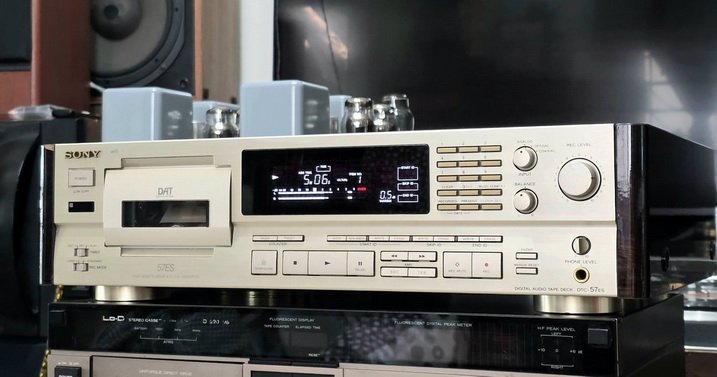
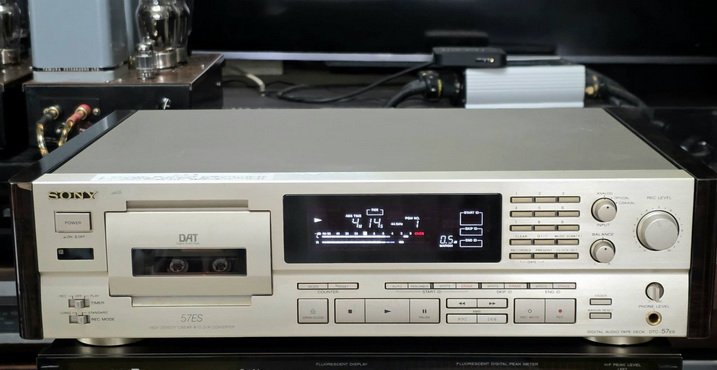
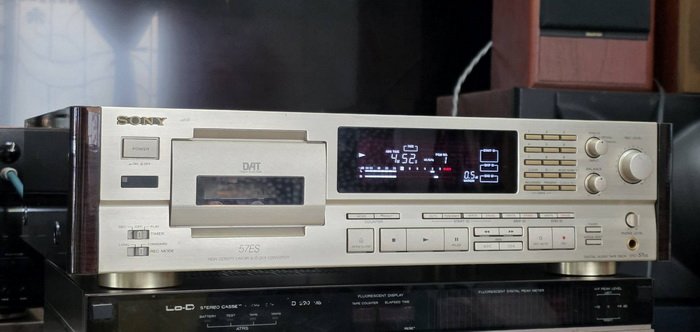
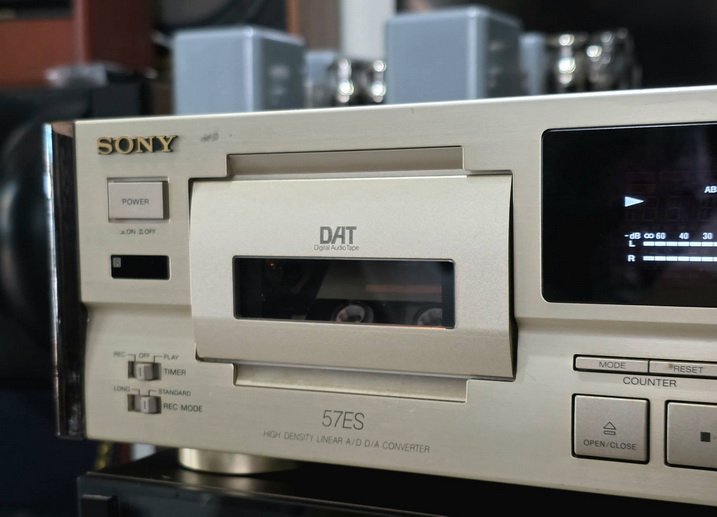
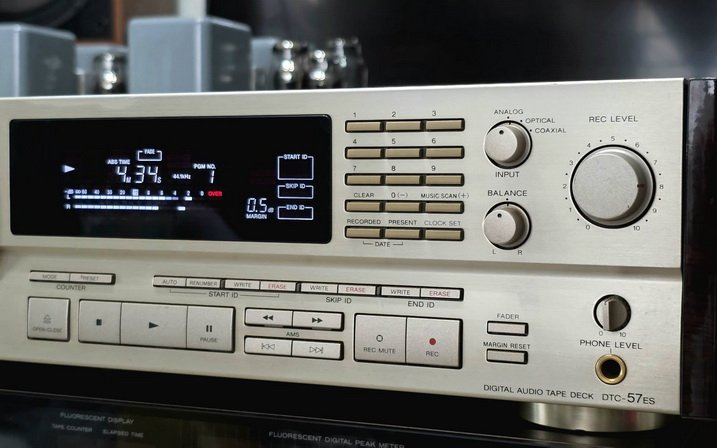
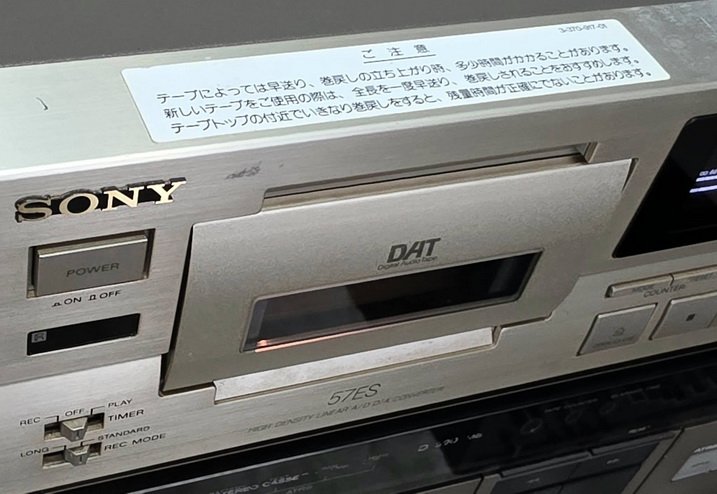
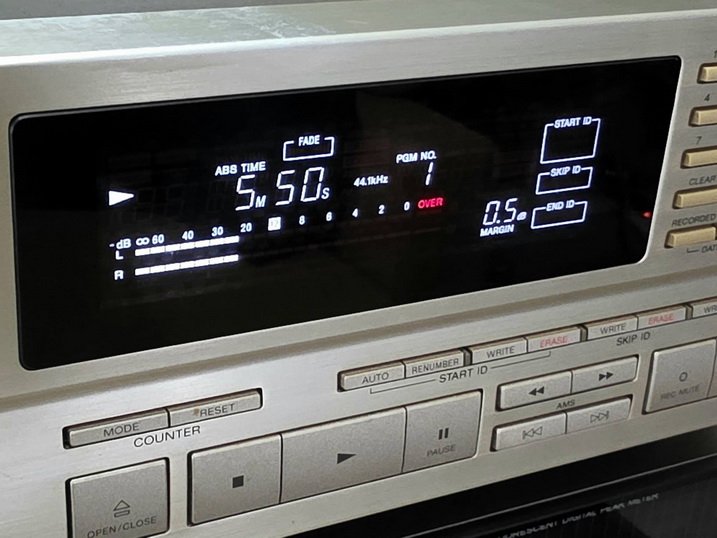
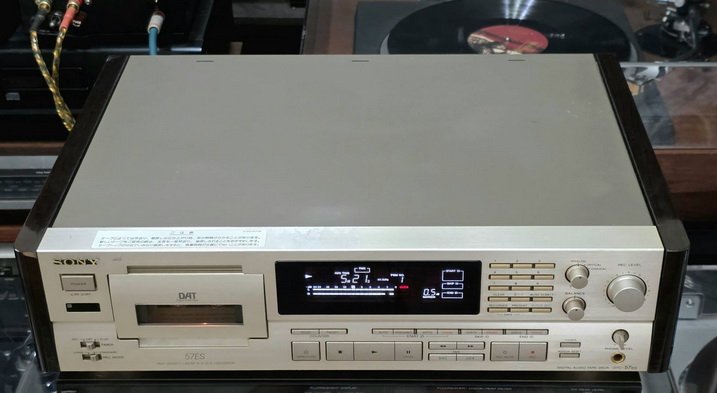
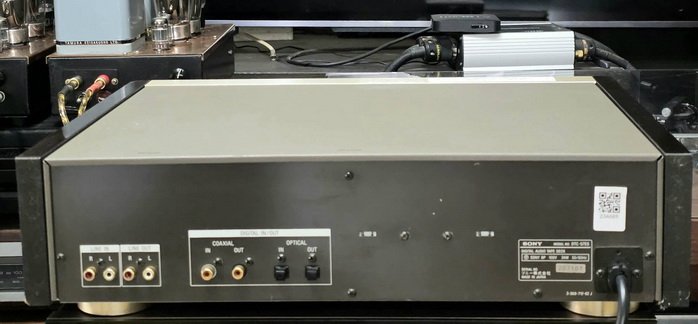
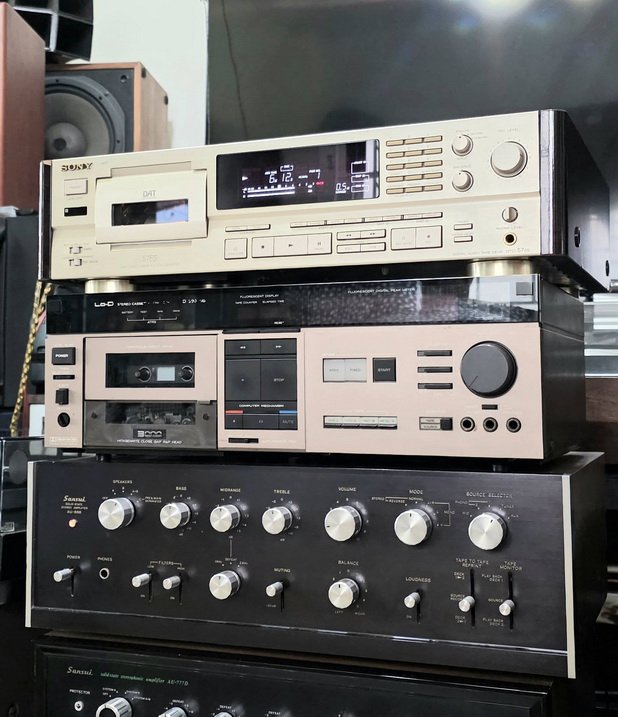
ขายเครื่องเล่นเทป Dat SONY DTC-57ES สภาพสวยพร้อมใช้งาน เสียงดีมาก Made in Japan
ขายเครื่องเล่นเทป Dat SONY DTC-57ES สภาพสวยพร้อมใช้งาน เสียงดีมาก Made in Japan
รีวิวร์ เครื่องจากต่างประเทศครับ ...
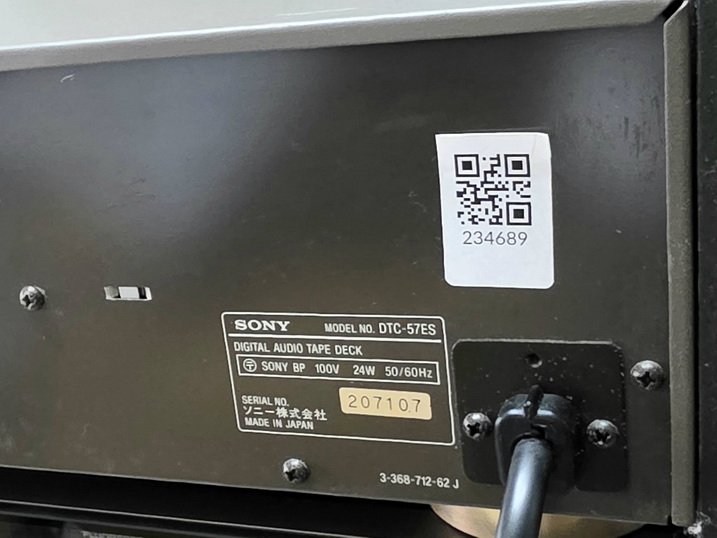
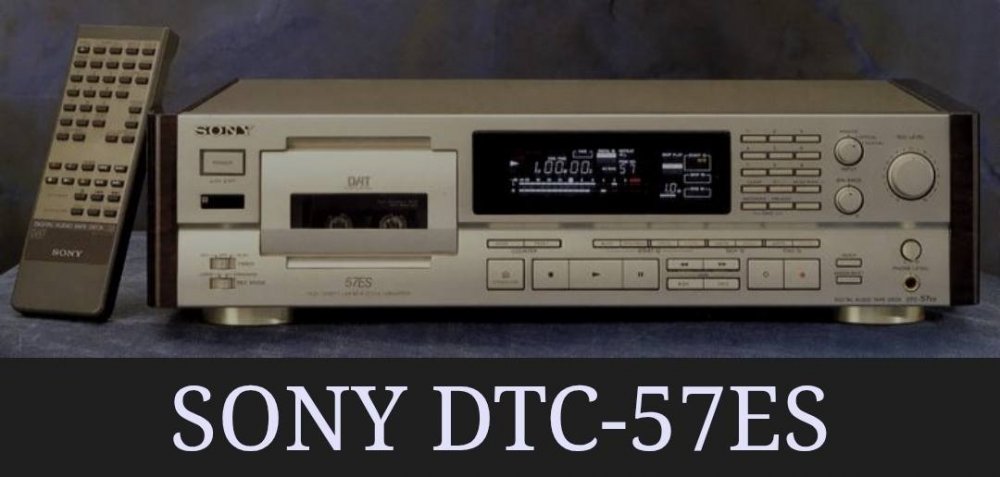
SONY DTC-57ES ¥ 88,000 (released in 1991)
Commentary
SCMS compatible DAT deck equipped with state-of-the-art pulse D/A converter and various
functions.
Equipped with SCMS (Serial Copy Management System), digital → digital recording from CD
player, which was impossible until now, is possible only for one generation.
A SCMS-compatible DAT deck can record digitally to digitally using a CD as a master, but cannot
record digitally to digitally using a recorded tape as a master. A tape recorded with an analog
input can record digitally to digitally for one generation using a master, but cannot record digitally
to digitally for the second generation using a master.
In the case of satellite broadcasting, it is also possible to produce digital second generation tapes
based on digital recording tapes of digital audio output.
In either case, recording can be repeated using analog input / output only.
A 2D. D. + 1 reel motor mechanism has been adopted, with dedicated direct drive motors for
the capstan and head drum rotation, and dedicated motors for the reel.
In addition, an upright see-through type compartment is used for cassette compartment.
The A/D converter is equipped with a 1-bit type A/D converter that can shift the unwanted
spectrum generated by the A/D conversion far beyond the band of the music signal. Therefore,
the low-pass filter that is inserted to prevent the generation of aliasing noise is also a light type
with gentle characteristics.
This minimizes the deterioration of phase characteristics and group delay characteristics.
A 1-bit type pulse D/A converter is used for the D/A converter.
This D/A converter uses a single electronic switch to turn on / off one current source at a high
speed of 5000 full bloom per second to express music signals as dense and coarse waves of
pulses. In principle, there is no glitch, 0 cross distortion, or differential nonlinear distortion, and
natural sound quality is obtained.
It uses a software servo that is a substantial software version of the motor servo.
With software servo, various controls can be performed only by software settings. Therefore,
in search and other operations, the tape can be searched slowly at the beginning and immediately
before it stops, and at a maximum speed of approximately 200 times (at standard speed) during
driving so as not to burden the tape.
It also helps to reduce sound generation time and improve cue / review sound.
It uses a newly developed second generation LSI that integrates signal processing such as
error correction, RAM control and digital I/O into a single LSI. This LSI has an integration density
of 20000 gates per LSI.
In addition, the microcomputer for controlling software servo and mechanism control is also
integrated into a single LSI, enabling a significant reduction in the number of parts and a
simple circuit board configuration, improving reliability and error correction capability.
It is equipped with subcode function unique to DAT.
The start ID is a subcode that indicates the beginning of a song. You can write the start ID in
two modes : Auto, which writes the start ID automatically at the beginning of the song, and
Manual, which allows you to write the start ID at your desired position. You can also erase
the start ID if necessary.
The Skip ID is an ID that is written in the beginning of the part you want to listen to when you
play the tape. If you find the Skip ID during playback, it is automatically fast-forwarded to the
next Start ID. You can delete the Skip ID later.
If the end ED is written at the end of the required part, it is regarded as the end of the tape, and
it is auto-rewound for playback and stopped for fast forward.
It is equipped with a rehearsal function for writing start ID and skip ID / end ID manually during
playback, and point writing of A ⇔ B repeat.
During rehearsals, the point can be moved back and forth in units of 0.3 seconds while listening
to and confirming the sound. The movement time is displayed on the display so that you can
easily write to the just point. In addition, the already written start ID can be corrected during rehearsals.
You can assign a program number to the Start ID, and you can select songs directly by simply
selecting the number with the 10 key during playback. The program number is automatically
assigned when recording, and can also be used to manually write the Start ID.
Equipped with a renumbering function that renumbers the number from the head of the tape
with one touch operation.
It is equipped with a Shift Number function that renumbers the start ID by adding it back in
0.3 second increments so that you can play the beginning of the track with plenty of time.
It is possible to record the absolute time which shows the absolute time from the tape top.
It is equipped with a date function, and based on the built-in dedicated clock, it can
automatically record the current year / month / day / day of week / hour / minute / second /
AM/PM in the subcode, and can be called up anytime during playback.
AMS play is possible in which you can start the previous or next song according to the number
of times you press the AMS button based on the song you are listening to.
It is equipped with program number search, and by using 10 key and play button jointly,
you can directly find the music which recorded the program number of the number you
pressed.
Equipped with a music scan function, you can search for the start ID one after another and play
it for about 8 seconds each.
The specified program number and the entire tape can be repeated.
Equipped with an end search function, you can quickly search for an end ID or an unrecorded
part that has never been recorded.
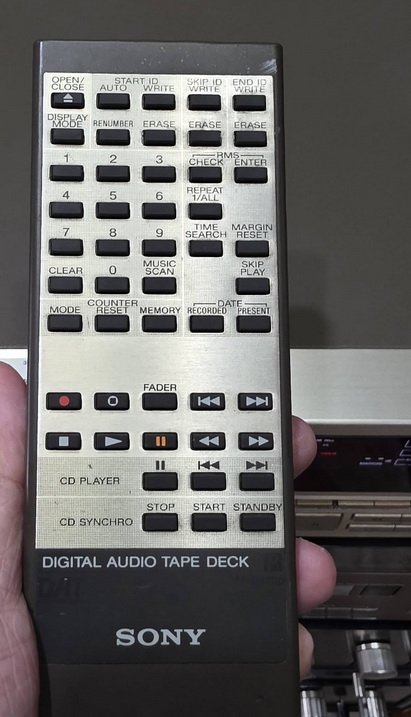
By using the included remote control, you can play 99 RMS songs by rearranging the
program numbers (songs) in the order you like.
Equipped with long play mode capable of continuous recording for up to 4 hours (when using
DT 120 r).
Fade in / fade out is possible with analog input recording and digital output / lineout output playback from tape.
The Fade In / Out Time can be set individually in a range from rapidly changing 0.2 seconds
to slowly changing 15 seconds. It is also linked with the Pause function, so it can be used when
editing and recording a DAT tape as a master to a cassette.
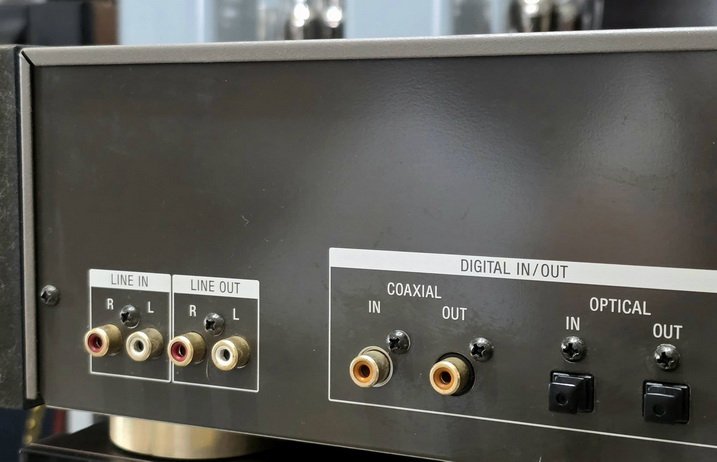
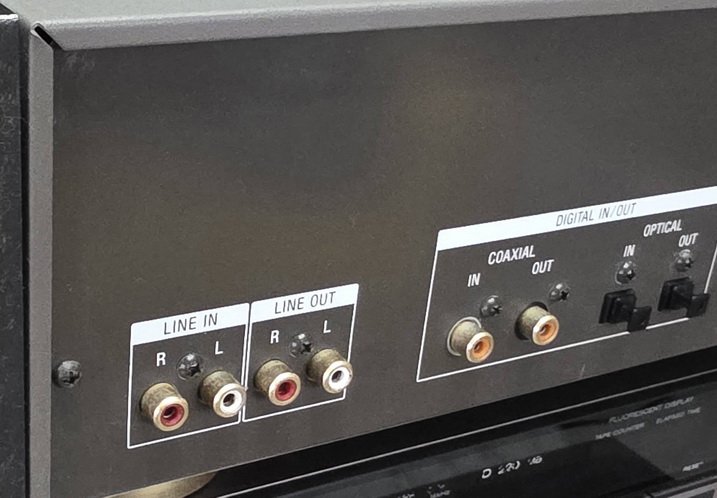
Equipped with equipped with two types of digital input / output terminals which are coaxial
with optical input. The optical input and coaxial input can be switched with a switch on the
front panel. The optical input uses a servo-type digital signal normalizer circuit which absorbs
cable jitter.
Digital peak margin display is available, and digital display is available in dB units to indicate
how much more recording level is available during recording.
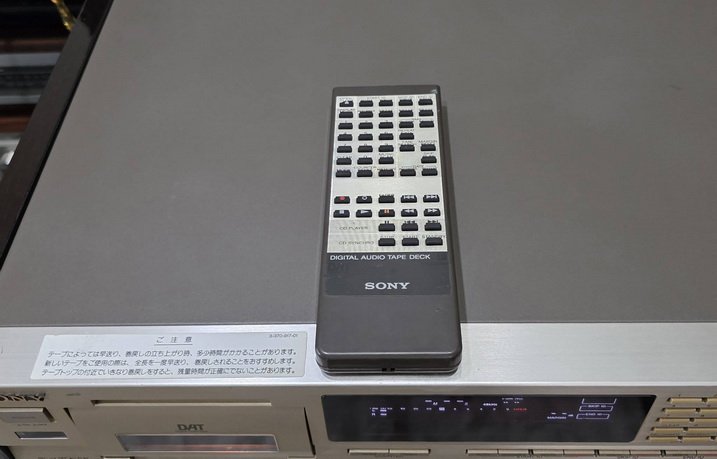
It comes with a wireless remote control that can operate most of the body.
This remote control can also be used to select music and pose for a Sony remote-controlled
CD player. Moreover, it can be used for wireless CD-synchronized recording, in which the
recording pose of the CD player is released and the CD player starts playing.
The fs map function, which uses a digital peak level meter, provides a visual indication of
the sampling frequency at which recording is being performed at an approximate location on
the tape.
The upper part of the meter lights up at 32 kHz, the lower part lights up at 48 kHz, and both
lights up at 44.1 kHz.
There are 2 variations, gold and black.
Also, the remote controller came with a color that matched each design.
Type DAT deck
Number of channels 2-channel stereo
Sampling frequency / number of quantization bits 48kHz/16-bit linear (recording / playback)
44.1kHz/16-bit straight line (recording / playback only for Digital in)
32kHz/16-bit straight line (recording / playback only for Digital in)
32kHz/12-Bit Non-Linear (Recording / Playback)
Error correction Double encoded reed solomon cord
Emphasis Pre-emphasis (for analog input during recording) is fixed to off
Automatic switching of de-emphasis (during playback) on/off
Modulation system 8-10 conversion
Frequency characteristic 2 Hz to 22 kHz ± 0.5 dB
Dynamic range 92 dB or more (emphasis off during recording)
Signal-to-noise ratio 92 dB or more (emphasis off during recording)
Total harmonic distortion factor 0.0045% or Less (1 kHz)
Wow and flutter Measurement limit (± 0.001% W. Peak) or less
Interface Analog Line in/out (pin jack)
Digital in/out (EIAJ-compliant coaxial and optical)
Pwer 100 VAC, 50Hz/60Hz
Power consumption 24W
External dimensions Width 470x Height 125x Depth 350 mm
Side Wood Removal : Width 430 mm
Weight Approx. 8.2 kg







 ได้รับการโหวต ความน่าเชื่อถือในการซื้อ-ขายสินค้า จากสมาชิกทั้งหมด 17 ท่าน